
Building a Business Without Chasing the Algorithm
I have been recording this podcast for over ten years, and I still love finding out how each guest weaves Pinterest together with another platform. This week I sat down with Julie Ciardi, a former IBM marketing and sales executive who now helps women near and over 50 find their voice and step into the work they feel called to do. Julie is also one of our clients, and she uses Substack in a way I haven’t heard before. If you’ve wondered where Substack fits next to your Pinterest strategy, or you’re tired of feeling like you have to feed the algorithm every day, this conversation is for you.
Related: Can Pinterest & Substack Work Together?
Creating Content for Your Clients, Not the Algorithm
Julie left IBM in her mid forties and started her business nearly nine years ago. Today she leads a community of close to 1,000 women in 30 countries, and she uses a reworked version of Human Design to help them see gifts they can’t see in themselves. What stood out to me most is that she decided early on not to play the social media game. She says she has spent more time creating content for her clients than for any algorithm. She records one podcast a week, runs a big launch only a couple of times a year, and invites people to join a free masterclass week so they can feel what it’s like on the inside. The paid tier on her Substack starts at $79 for the year, which works as a small hand raise from readers who want more. Her team follows up with real humans, not automation.
Why Substack Became Her Home Base
Julie was clear that Substack is not a social media platform. Notes is just one small piece, and when she ran two campaigns for paid workshops, only 1% of the buyers came from Notes. For years her business lived on separate islands: a podcast host, an email platform, and a WordPress site. Now she has moved all of it to Substack. She records her podcast, grabs the transcript, and the episode becomes its own web page. That page shows a different call to action depending on whether the visitor is a free reader, a paid subscriber, or not subscribed at all. When she hits send, the episode goes to her email list and her website at the same time. Her live videos turn into captioned clips for YouTube and Shorts, and the platform even creates shareable graphics, so she doesn’t need to open Canva. The cost for her website, email, and podcast hosting is zero, which is a big deal for solopreneurs and small teams.
How Pinterest and Substack Fit Together
This is where it gets fun for us. Every long form post, podcast episode, or video on Substack has its own URL, so Pinterest has something real to send people to. Julie sees it as hand in hand, like blogging but more dynamic and simpler. I said Pinterest users are readers, and Julie rightly added that they are also viewers and listeners. She is a speaker first, so she talks into the mic, takes the transcript, and uses Claude to turn her exact words into something readable. I also shared that Pinterest users crave depth and authenticity, and they push back on AI slop. Julie told me she wants to start thinking about Pinterest ads for her best content too, which made me smile.
Related: What’s Working with Pinterest Ads in 2026
Be the Tortoise and Skip the Rabbit Holes
Julie talked about how the internet marketing world feeds on our angst, and how every new thing is another white rabbit pulling us down a rabbit hole. She decided she didn’t want to be an internet marketer. She wanted to be a tortoise, and she now has a multiple million dollar business she loves. Her take on AI stuck with me too: you don’t need to spend your time learning AI as much as you need AI learning you and your own ideas. I pointed out that Pinterest is the tortoise of platforms. It’s slow and it’s a snowball, but it keeps bringing the right people. If you want to start on Substack, Julie says to change your mindset, write for your best clients (or your dream clients), let go of viral hooks, and push your content out to Pinterest and other platforms. If this inspires you, go follow Julie so you can see how she does it.
Related: Pinterest Wins: When Pinterest Keeps Working While You Pivot
You can find this podcast episode by going to Apple or Spotify.
For More Pinterest Marketing Resources:
Follow Julie on Substack: https://substack.com/@julieciardi
Shop: Turn every Substack post into a pin with our Pinterest Templates
Watch: How to Pin in Your First 30 Days on Pinterest
Thanks to our sponsor Lulu for supporting this episode
You know that feeling when someone says something, and it just lands differently because it’s coming from them? That’s what a book does. It’s your voice, your story, your expertise, in something someone can actually hold. But here’s the part people miss: it’s also money on the table.
A book is one of the lowest-lift products you can add to your business. No inventory to buy upfront, no new team to hire, no huge build. Just something you already know, turned into a new revenue stream that keeps selling long after you’ve written it, while still sounding completely like you.
That’s what Lulu makes possible.
Check out Lulu using the link in the description.
[00:00:00] Real quick, a huge thank you to our sponsor, Lulu, for supporting this episode. I used to think that expertise had to live in one place: a course, a membership, a program. But then I learned that it actually doesn’t. Some people wanna learn from you live, some people want to learn from you in a program that they can binge at their own pace, and some just want a book they can read in their own time, no login required.
I felt this way myself when I read the book Sponsor Magnet. I picked up the book, and it opened the door to me to their whole brand. Sure, they had a course, but I didn’t have time for that. That’s actually a Lulu book, and it’s a perfect example. It wasn’t competing with their other offers. It was actually a way in for me.
I would have never signed up for a course cold, but I absolutely bought the book. That’s a whole audience you might be missing in your business. That’s a whole nother revenue stream you might have available to you. Lulu makes it real, [00:01:00] so I want you to click down below on the link in the description and learn more about Lulu.
Hey there, and welcome back to another episode of The Simple Pin Podcast. I’m your host, Kate Ahl. I have been recording this podcast now for over 10 years, and every time that I get on to record with a guest, I’m always curious about what it is I’m going to discover because each guest has a method to their madness, a way that they figure out how to weave together Pinterest with maybe a platform, and in this case, it’s Substack.
So Julie Ciardi is leveraging Substack in a whole new way that I wanted to highlight. We had another episode about Substack with Carla Contreras, which was really great, and I wanna present this option as well as two different ways that you can use it, and Pinterest works for both. But there is a really great aha in this episode that I want you to catch, and it’s all about how Julie creates content and who she [00:02:00] creates content for.
And I think that’s really important right now, especially in this day and age where you can create content for tons of different people and get caught up in the algorithm, and we have this deep and rich conversation about exactly that. So I know this will inspire you to really figure out how to create content for the right person in your ecosystem and also leverage Substack in a way that frees you up to create amazing content and pair it with Pinterest.
All righty, let’s dive in. Julie, welcome to The Simple Pin Podcast. I’m so excited to be here. I feel like this conversation has been waiting to be had. It’s gonna be good. Yes, I agree with you, and it was one of those things that I wanted to have this summer, and then it was October, and actually, this is the perfect time.
Because in all the things that are happening right now online and the conversations around, like yapping and AI agents and all of this, I feel like you’ve chosen a business that really [00:03:00] relies on serving your customer, your community in a way that is so authentic, and it kind of, like, drowns out all the noise.
So I wanna start there. Tell me a little bit about your business and what the core foundation of it is. Yeah, and thank you. I started this business eight, almost nine years ago. Seven years ago it really started to pick up steam, and it’s been always the same mission, and the mission has always been to help women find their voice, to get their calling out into the world, their purpose.
It’s kind of what happened to me. I worked at IBM. I was the vice president of marketing and sales at IBM. I made the decision to leave 10 years ago at 42, and then left at 44. And so I know what it’s like to be kind of going into the second half of life, starting kind of a new business, a new chapter in life and what that can entail, and so I really [00:04:00] help women.
But over the last several years, I actually kind of moved the needle of who I was helping, and really it became women near and over 50. And so this just lights me up so much, that we’re helping women who are ready to leave the boardrooms, the classrooms, the operating rooms, wherever they kinda had their first career.
Their kids are leaving, you know, the nest, and they’re ready to actually pursue the work that lights them up, the work they feel called to do in the world, and that’s what we do. We help them. We bring it back to business basics. No going viral on social and all that stuff, and really helping them to get their voice heard and to…
What we bring in is, I actually rewrote the whole human design system to actually help bring in some clarity for them, because one of the biggest pieces we find, especially for us women, is we can’t see our own gifts. We can’t [00:05:00] see how amazing we are. And so we have found that by using that tool, it’s really helping them to find their voice and to see how incredible they are.
And we’re a community of nearly 1,000 strong now in 30 countries around the world, and it’s just been like the joy of my life building this business over nearly a decade. And you know, one of the things I think that is so unique about targeting this age of women is that a lot of women over 50, I just turned 50 last week, and you feel this element of not being seen or not feeling like you do have value or, to your point, not seeing your gifts, a lot of it because you have been investing in so many other places, that you’ve been looking outwardly, that you haven’t had this opportunity to look inward and say, “Oh, I am good at this.”
And so do you find in your community this series of aha moments that these women have all the time? It’s so cool. It becomes these moments of [00:06:00] confirmation. Like, I get the chills when I say it. I always say it takes courage before you can even get confidence in something, right? And so first of all, they’re courageously actually taking the time to get to know themselves, and it’s like truly that’s what they’re doing.
They’re like almost reintroducing themselves to their self after all the decades of giving and like you said, investing in all these other places with all these other people. And so when they begin to actually just take a beat and they actually do start to do the self-reflection and they do start to look in.
When they begin to study, especially their design, and really see what they want, they actually get so much confirmation of what they already know. Like, they already know that they have these talents and these gifts and that this is why people come to them and this is what they’ve always felt called to do.
It’s getting back in touch with that, and it’s just so incredible to see, and the epiphanies… It builds [00:07:00] this courage and this confidence to, like, take that next step. Because I know it happened for me. I mean, I was very successful at IBM, but the second I stepped into the arena of entrepreneurship, I immediately put myself down as a beginner.
I’d felt like I didn’t know what I was doing, and I actually threw out all the accomplishments and success that I had gotten to that point thinking they didn’t matter. But actually, every step of the way matters, leading us up and grooming us for that next phase, right? Which very, very, very often happens right around turning 50.
And what’s really fun is actually them not just understanding what it is they wanna do into the future, but they actually get confirmation of the path that got them there, and that it was all part of the plan, right? To develop the wisdom and their talents and what they’re here to share with the world.
So it’s [00:08:00] just… I pinch myself. Yeah. I absolutely love what I get to do every day. Yeah. Okay, so you’ve chosen Substack. That has been your vehicle of choice in connecting, which is interesting, because if we think of the over-50 crowd, automatically your brain goes to Facebook. You think of a Facebook group.
But you’ve purposely chosen to invest in Substack. Tell me a little bit more about why. Yeah. I mean, I should probably preface it with: I decided I was never gonna play the social media game very early on. I knew I didn’t wanna be an Instagram influencer. I didn’t wanna be YouTube famous. Like, that just wasn’t the model I was looking to go after.
I actually really wanted to do work with my clients. Really, it’s been almost a decade, but the last seven years is when I’ve had this particular group program and building the business as it is. And that’s what I’ve been doing. I mean, heads down in the business. I actually literally just put a note out on Substack today [00:09:00] where I said that over the last seven years I have spent more time creating content for my clients than I ever have for an algorithm or a market.
And that has been true. For seven years, I have focused on work with our clients as the most important thing. And so actually, what ends up happening is that only a couple of times a year do I do a big marketing and sales kind of launch because I wanna spend all the rest of my time with my clients and developing intellectual property and systems and content with them, which is now paying off in dividends in a lot of ways, but especially with AI, because when you can feed your AI, your own AI with your brain of all that codified knowledge, it just…
You can go to the next level. But unfortunately, what happens is people play the content hamster wheel game instead, and I just knew I could see it. I just knew [00:10:00] that’s not what I wanted to do. The idea to me of creating content that basically disappears from anyone’s eyes within about 24 hours or less, I’m like, “Oh, no thank you.”
I still get emails. I still stay on some of the email lists ’cause I love how it fuels me when I see some of the subject lines of like, “Learn how to create 400 reels in 20 minutes,” right? And I’m like, “That sounds horrible.” Like, I want nothing to do with that.
Yep. I just knew I didn’t want this crazy amount of content that I’d have to create at scale that maybe, hopefully, crossing my fingers and toes, someone might see. That game never was appealing to me, and so I never played it. And so really, I’ve never been dependent on any platform, honestly.
I am always dependent on what I call other people’s audience. I’ve been doing podcasts on other people’s [00:11:00] podcasts forever. I go into other people’s groups and teach. I definitely do paid ads because I’m not gonna take a chance on this organic game, especially now with AI driving so much content, not necessarily AI-created content, but with AI automations, people can put out astronomical amounts of content organically that it’s like, do we wanna even try to compete in that game at this point?
Never wanted to before. I definitely don’t want to now. And so when Substack… And Substack’s been around since like 2020 or even before 2020. It was definitely more of like a pure newsletter platform initially. But I wasn’t interested in any platform, to be perfectly honest. However, when… I guess it was just about a year ago, I started to hear more about Substack.
My mentor was talking about it. Big, especially if you’re writing books or you have a book, and I’m like, “Okay. Well, I have my book. I have my 50 not finished book. I have another book coming out in January, [00:12:00] so okay, maybe I’ll go and check this out.” Well, I’m definitely a business strategist.
I mean, I have my MBA, I was a marketing and sales executive at IBM. The way my brain thinks, I think you’re very similar in this way. Like, we see things and we’re like, “Oh my God, the opportunity,” right? Right. And so what blew my mind when I actually looked at Substack from that strategic lens is it’s not a social media platform.
It’s just not a social media platform. There is an element of Substack that is a social media platform. It’s called Notes, and that could be like your feed on Instagram, right? Or LinkedIn or whatever. It’s just a feed. But that’s one piece, and so of course one of the big mistakes I see is that people just wanna go play the same game they’ve been playing on every other platform in the Notes feed.
I don’t even bother. In fact, we just ran some analysis where we ran two campaigns to two paid workshops, [00:13:00] and we did so just through Substack, and only 1% of the people that bought the workshop came from Notes, came from the social feed. That’s great that it has the Notes.
Fine. Whatever. But what it is is it’s a new way to publish content. It’s really a publishing platform. Wait, I haven’t even told you all the things I’ve moved over there. For nine or so years, I’ve had all these islands. I had my podcast on Libsyn. I had my email on Kit. I had my content over here.
I had my WordPress site over here, right? (Yes. Yep.) And it required humans and processes and all the things, and even with AI and automating some of that, I mean, that’s just a lot that has to be done. Substack brings it all into one. You’re all on the same island. So I moved my podcast over to Substack, my website over to Substack.
I moved my email over to [00:14:00] Substack. I moved everything to Substack. So what happens, let’s say I do my podcast like I would normally do my podcast in a week, and I love to do at least one a week, but I’ll do even more now. I record my podcast. I grab the transcript of it so I can also create an article from it.
Think of like old school blog posts. It’s now its own website. I know we’re gonna talk about Pinterest. Now, you can drive traffic to every single podcast episode, but be able to have it be literally a web page, right? So with the article, with anything you wanna be able to put in there. It knows whether someone’s on your Substack list or not.
Are they a free reader? Are they not subscribed at all? Are they actually on your paid tier of Substack? And it dynamically changes the call to action based on who’s visiting. I had a WordPress site for nine years, right? It didn’t know who was coming, right? [00:15:00] What content should I tee up for this person, right?
What call to action? So when I do a podcast and I put it up there and then I hit send, it automatically goes to my email list. It automatically gets published to my publication, which is now my website. So instead of like, “Oh, now we gotta go get the podcast episode up on the WordPress site as a blog post or a podcast post,” everything gets done automatically, and it’s so genius.
And then let’s say I do a live video over there, right? So let’s say I’m actually gonna do an interview. I go over there, I use that as my interview platform. When I do the interview, okay, the video downloads. It automatically makes clips with captions. Beautiful. You can make more if you’d like, but it automatically makes clips, and it automatically will post to YouTube and make YouTube Shorts. Like that.
Everything is done for you. [00:16:00] And I know a lot of my women are either solopreneurs or they’re entrepreneurs with very, very small teams, and the amount of work that it eliminates, but also, like, it does things smarter and more efficiently and effectively. So now let’s say I’m about to go live, I’m gonna teach on something in Substack, and I’m only doing it to my paid members.
The email automatically goes out to my paid members, “Julie’s live on this topic doing this.” My team doesn’t have to send another email, right? Same thing when it posts as a replay. If it’s to the entire list, I go live to the entire list, but it’s taking care of all of that for me. So it’s doing the distribution, it’s doing the communication.
And because of things like ads and Pinterest, that content, that gold content, the podcast with the article and, like, the juiciness of it, I can keep running [00:17:00] traffic to it. Right. I can run traffic via Pinterest. I can run traffic via ads, and traffic ads are, like, so cheap. And then the page does the work for me.
Want to read this later?
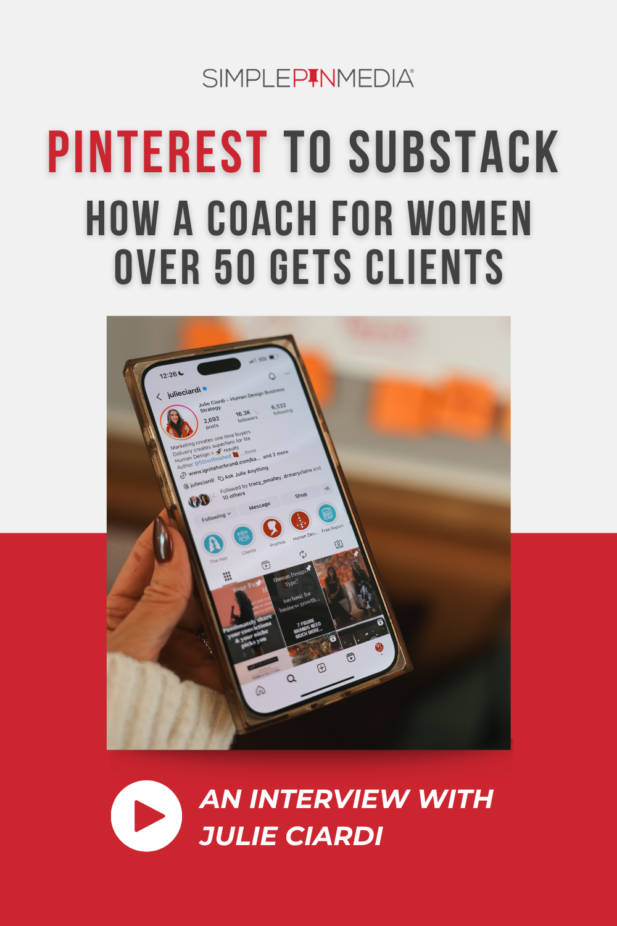
So it’s been life altering as a content publication, a publishing platform. The other crazy thing is it actually creates all of the graphics (if you go to my Instagram, you can see a lot of them), and lots of different beautiful views of the podcast, of whatever, or the article, or the live video, whatever you’re doing.
Because it’s multimedia, so it’s video, written, or it’s audio, and it creates the actual shareable graphics as well. There’s no more going into Canva to create. (Right.) It’s just all done. No heavy lift. And if you ever wanna switch it up, you just go in and switch out the photo that’s on that page.
[00:18:00] New graphics are formed. Right. Just like that. Well, it’s blowing my… I know. Okay. No, I love it. And actually, I think you said something that I hope people catch, is you said, “I’m creating content for my clients.” And when you said that, what I heard was, instead of creating content that’s gonna be this big, huge net and you’re gonna, like, hope you reel somebody in, you’re creating content for your clients, and those people who are already in your community are going, “Yes, Julie, I love this.
This is amazing.” And then they’re telling their friends because they’re now… They’re saying, “Hey, this is so awesome. You can see this, but imagine behind the scenes.” It’s a mirror, which you and I talked a little bit before about how there’s this kind of marketing facade.
There’s this thing we see on the outside, and then there’s things that we see on the inside. And you’re essentially saying, “No. If you’re not a client yet, [00:19:00] you’re getting it as if you will be a client.” Am I correct on that? Yes, 100%. So for example, I do it a couple of ways.
So I do my weekly podcast once a week, and that’s for everybody, and it is what it is, but I don’t kill myself in content creation for the algorithm. I just don’t. I create one thing a week. That’s it. And then what I end up doing is when I’m ready to kind of like, do a launch or open the doors to what we’re doing, then we actually do exactly what you’re saying.
We’re like, “Come on in. Come join us for a week. See what this feels like to be on the inside for, like, a week with us, and I’ll host, like, this free masterclass.” They get to really come in and feel it, and then we close the doors, and we’re back to, like, serving our clients. And so on a day-to-day, week-to-week, 90% of the year, my focus is on the clients, and it’s writing content for the clients.
And the neat thing about Substack, the other thing I’ll say about that, which is similar [00:20:00] to what you’re saying, anything that I create that’s just for my clients and I host it on Substack, everyone can see it. They can’t, like, consume it, but they can see what’s available. So they can see, oh, she did a training and a video on this topic.
Wow, that looks really amazing. But it’s for the paid tier. And the paid tiers of Substack, like, they’re very small. $79 for the year is, like, the initial entry point to my paid tier, right? So what it does is it actually, instead of like, think of Instagram, where it’s like spray and pray with no ability for people to raise their hand one way or another other than, like, automated DMs and all this stuff, right?
Here, people are opting in by saying, “You know what? I’m really loving what she’s doing. I’d love to learn a little bit more,” or, “She’s doing this workshop next week. It’s 79 bucks for the year. I’m in.” They’re upgrading in, for a very tiny price point, but it’s a [00:21:00] hand raiser, right? They’re saying, “Oh, I…”
It’s qualifying, right? Now you’re getting qualified leads to literally pay you, and then we have a whole process with actual humans where everyone that comes in, we’re actually connecting with them on the back end. It’s a human. There’s no automation. I love that there’s no automation in Substack.
It’s literally actual humans talking to humans and making sure, “Hey, did you see this workshop?” Or, “We did this and just wanted to connect with you. Here’s our getting started guide.” And that touch, people are loving. It’s almost like having a paid audience for then other things as well that you wanna be able to offer.
My whole philosophy has been anything that’s gonna help me to spend more time doing what I really wanna do, which is to deliver to our clients, rather than delivering to [00:22:00] an algorithm or a platform in the hopes that maybe it’ll work. And so Substack has helped to fuel that strategy.
It’s been incredible. I am so encouraged by this because I think there’s a lot of people in the online space who are so overwhelmed. You actually… I’ll have you share it here in a second, but that tortoise and the hare analogy is that we all feel like we need to be doing more, we need to be racing more.
And a lot of what you’ve talked about is taking Substack and centralizing it, and that when you do that, you actually free up more of your creative space, more of your brain space to be able to communicate with your end user, reader, purchaser, whoever, because the noise of the rest of it is now gone.
It’s so centralized. So I’d love for you to share what we were talking about before we started, because I think especially right now, there is this fervency that everybody feels, and automatically you feel one step behind. You open up Instagram and you see one [00:23:00] reel and you’re like, “Well, I’m 10 years behind everybody.
I’m never gonna know how to do any of this.” But how can we embrace a new philosophy that is not so angsty? Yeah. I mean, it’s so hard because the internet marketing model feeds on that angst, right? So the second we start to feel we’re behind, then we get the ad that says, “This is the very next thing you should do to not feel that way anymore,” right?
It knows, right? And it’s 50 Master and this and all the other things. Yeah. Like, you know, create 20 AI employees and agents and all these things (Yes.) and all this craziness, right? I use the analogy of the tortoise and the hare, and the funny part about that was when I was really, like, thinking about this.
I love thinking about, like, these things. I was actually laughing to myself because every, like, month it seems, there’s a new thing, right? And those are the white rabbits, right? So remember Alice in Wonderland and the [00:24:00] rabbit, like, the white rabbit would bring her down these rabbit holes. Well, that’s what’s happening with the hares.
The hares, the rabbits. It’s like these internet marketers who are really good at what they do, right? They’re really good at internet marketing. I made the decision I really don’t care if I’m good at internet marketing. It’s not why I left IBM. I don’t wanna be an internet marketer. I wanna be a transformational entrepreneur that helps people.
I don’t wanna spend my time on ROAS, churn, dashboards of, like, all this data to tweak automated webinars and funnels. I’m like, “That is not why I left a nearly half a million dollar salary to do that. Don’t wanna do that.” So what happens is that people who are really good at that make a lot of money selling the next thing that’s going to cure the angst, and it’s gonna maybe be the fastest way.
So it’s all these rabbit holes, rabbit holes, rabbit holes, and we get sucked down into them. And then when we do, we get further pulled away from what we’re actually here to do and what we’re [00:25:00] actually here to focus on. It’s why I try to be very careful about any time I’m spending on any of the platforms, because it literally will suck you down a rabbit hole potentially.
And right now, a big one is AI, right? Everyone wants… A lot of people are making a lot of money selling AI, right? A lot of people are affiliating off of people selling AI, and here is the thing. That’s fine. It’s fine, but I’m of the philosophy that you don’t need to spend your time learning AI.
You need to spend more time AI learning you. And if you are not building the depth of content of your own intellectual property, what you deliver to clients, of what makes you so unique and different because of what you bring to the table of your paying clients, that’s the best gold that you can possibly be leveraging AI for.
But everyone just wants to learn how to do all these things in AI. And so what’s happening is that, like, I’m just noticing… And I… Listen, I get sucked [00:26:00] down the holes too, right? I’ve gotten just a lot better about it, right? So when I was first starting my business, phew, like seven years ago, nine years ago, I would say probably five years ago I started to get much better about being like blinders on, stop going down the rabbit hole.
You aren’t signing up for everything? Correct. Yes. Correct. Correct. And then when I put those blinders on and I just started to, like, focus, I said, “I’ve been the tortoise this whole time.” Like, I’m not internet famous. I’m not super well-known. But I have a multiple million-dollar business that I love, so I’m okay with that, right?
I’m okay with that because I’m not here to try to become famous, or rich or whatever, or to fly private. I’m here… I left that big job and career because I really wanna love what I am [00:27:00] doing every day when I wake up. Being 52 myself now, like I am very well aware that I only have so much time on this planet, and I want it to be doing the things that light me up.
I have three kids. Two of them are already out of the house. Like, I wanna feel fueled by the work that I am doing in the world, and that requires us to have some discipline about actually betting on ourselves and betting on the value that we’re really here to bring ourself out into the world, and to try to quiet that noise because it causes a lot of anxiety, fear, you’re behind all the things.
And then it actually, like, keeps you from the good work you’re supposed to be actually doing in the world instead. Yeah. And you know, actually, there was an interesting connection in my mind that was made as you were talking. You know, bringing it back to Pinterest in this way is that Pinterest is the tortoise of any type of social media [00:28:00] platform.
And we don’t put it in social media, obviously we put it in search. But it’s the biggest hurdle for people because it doesn’t feel like the hare. It doesn’t feel like this whole sexy product where you’re getting into all these other things. And so people look at it and they go, “I don’t know if I wanna invest there because one, it’s slow-moving, two, it takes time, three, I know it’s a snowball, I know it’s gonna build, but I don’t know if I have the patience for that because I’m so drawn to these flash in the pan moments that make me feel like I’m doing something.”
And that, I think, is the trap that we have to overcome a lot on our side, is convincing people, “Hey, guess what? If you do use this over time, it is still bringing the people that you want to the platform that you want in order to get the results that you want. Whereas you don’t really know what’s happening on this whole Instagram side.
You don’t know how that’s working. Somebody could like something or view it, but that’s it, right?” Or even think of YouTube. Even think of YouTube. Yeah. YouTube drives me crazy, [00:29:00] right? Because really, what’s the game there? Yeah. Is the game for YouTube to pay you? Or do you wanna be paid by people (Right.) who
value you? Yeah. I don’t wanna be paid by a platform. Yes. I wanna be paid by… I don’t wanna be paid for views. That’s not the business model I wanna be in either, and I think it’s the dopamine. Yeah. There’s the dopamine hit of the fast thing. Like, it’s such an illusion because it feels good in the moment, but really there’s no results.
The thing I love about Pinterest, and it’s why… It’s funny, before I was getting on the call with you today, I was thinking to myself, I forget how long it’s been since I started to work with you and your agency on Pinterest. This is where it also requires people to…
And I remember this at IBM, like we used to have this thing with marketing and ROI, right? And the CEOs are like, “Well, we gotta know what the ROI is.” And it’s like, well, you [00:30:00] can’t always attribute everything so perfectly. To me, it’s foundational.
To me, why wouldn’t I have some of what I think are some of my best pieces of content having traffic go to it because it’s coming up in search, it’s part of Pinterest, it’s like I really actually wanna also start really thinking about doing ads with you guys too. Like why wouldn’t I, if I’m building the content that I’m building on Substack?
Now I think that people that are on Substack should heavily be thinking about optimizing using Pinterest because… And this is what I try to tell people. I think if they weren’t bloggers from a long time ago, sometimes they forget to see Substack like this.
But that every single piece of longer form content that you create on that platform has its [00:31:00] own URL, has its own link, has its own landing page that can literally continue to live on. It just makes so much sense to me that you would totally pair Pinterest with Substack, like hand-in-hand, because everyone remembers Pinterest and blogging.
That’s what it is in a lot of ways, but more dynamic. It’s like, it’s more dynamic than a traditional blog, and it’s so much simpler. And so I’m a huge fan, as you know, of pairing Pinterest with Substack. Yeah. And people on Pinterest are readers. They’re ready to consume something that is a longer form piece of content, whereas Instagram users are not so ready for that because they’re used to the scroll up and down, read the caption.
Whereas the Pinterest user knows they have to leave the platform to get more information. And the one thing that they crave, and the one thing that they push back on the [00:32:00] platform is they don’t want any of the AI slop. They don’t want any of the inauthenticity. They want this really deep, rich relationship where they can read something, get to know someone, and feel like, “Yes, I got the answer to my question.”
And that is unique. There’s really no other platform that has that type of user ready to invest so much in themselves instead of the lives of other people, and I think that’s what makes it work. And I’ll just make one correction. They are readers and viewers and listeners, and I… (Oh, yeah. Mm-hmm.)
That’s also the part a lot of people just immediately think Substack is you have to be a writer to be on Substack. I’m not a writer. I am not a writer. I’m a speaker first and foremost, and the way that I create content on Substack is I get behind my mic, I talk about what I wanna talk about. It goes up as an audio podcast.
It goes out onto all the RSS feeds just like a regular podcast, and I then have the article [00:33:00] underneath it. I take the transcription, and I basically have a way of being able to very easily with using the way I’ve set up Claude to just take my exact words and make them more readable for my own transcripts, and that becomes the content.
And so it could be audio, it could be video. There’s some people that really just do great when they hit live on the camera and they just start doing video. But all of it can then be turned into reading, right? The video can go into audio. So I think what makes me so excited about it is that we’re all so different, and we all have different comfort zones of how we create content, and it’s really great because it really meets everyone where they’re at, which is really, really cool.
Yeah, I agree. This has made me so excited. Like, I have all these ideas for not just ways in which to leverage Substack, and obviously we’ve been leveraging Substack, Pinterest. We love that combo. We will sing it from the rooftops. But I think even more so for somebody who is starting out in [00:34:00] business, where they are wondering…
They’re looking at a tech stack, and they’re looking at all these things they can pull together. And what you’ve just said is there’s a one-stop solution in Substack that will allow them to accomplish a lot of different mediums and to just start to do it. So actually, that’s a really great question to end on.
What would you tell somebody who’s listening to this who is inspired and they wanna take the next step with Substack? What would you tell them to do? Yeah. And I am with you 100%. I mean, I don’t think there’s a more simple way to start a business that is service, information-based, you know, like transformational-based type of business…
There’s nothing simpler and less expensive. It’s $0. That’s the other thing. When I think of what that tech stack cost me initially when I was first starting my business, all the pieces, Substack is zero. Zero. Zero for your website, zero for your email, zero for your podcast hosting, all of it zero, right?
Incredible. I could sing that from the [00:35:00] rooftops. But what I would say is, if long form’s not your thing, Substack might not be your thing. But for so many people, actually, they have a lot they wanna say and share. And to me, the way I would look at Substack, if you’re gonna start on Substack, you have to change your mindset about it.
You can’t go into it thinking this is Instagram or TikTok or LinkedIn or anything. What you actually wanna do, and it’s kind of how we started this conversation, you actually want to create content there like you are creating it for your best clients you’ve ever had, or if you don’t have clients yet, the clients you would dream to work with because it’s this intimate…
It’s kind of like the podcast. I’ve had a podcast since 2018. It’s always been the place that I have felt most connected to my person because here’s what I know. A person who’s going to [00:36:00] actually listen to my podcast or read a Substack, right? It’s a different kind of person. They’re invested in that longer form.
They’re actually also invested in me because anyone that’s gonna listen to someone’s podcast, we all know we have the different podcast hosts that we like to listen to, we are invested in them. Like, we get excited when a new episode comes out and all those things. That’s what Substack brings. People are not sitting there waiting for me to do my next post on Instagram.
Like, no one. No one. Even, like, my mom. Like, you know what I’m saying? No one. (Yes.) Right? But people can’t wait for the next podcast to come out. People can’t wait for the next juicy piece of content that’s gonna come out onto Substack. And they get emailed it, so it’s like, it’s not just, “Oh, I hope they see it.”
They’re actually gonna get an email that I just did this piece of content. Like, I have a really exciting one coming out tomorrow, and I can’t wait for, like, all of my subscribers, right? It’s why I move my email list too. It’s like, I want all my subscribers to get this with [00:37:00] one… I just post it and it goes to them.
So you wanna create content that’s for your best possible people. Forget thinking that you’re trying to create content that goes viral, that you’re trying to create content that has a hook that’s gonna bring someone in or… Like, you have to, like, actually let go of all that and create for your person.
That’s the key on Substack, is that’s how you’re showing up because that’s when you’re gonna have the most authentic content that’s gonna really, really get out there. And the other thing I’ll say about Substack is at least at this time, there’s still opportunity around organic on that platform, which is really nice.
There’s a lot of recommendations, and what you’ll find is very quickly, whatever you go research or look up on Substack, very quickly your whole feed is mostly that. When I go into Substack, I just feel like I’m surrounded by women near and [00:38:00] over 50 at every turn. I have maybe one random person that’s not in my arena.
So that’s huge because you’re going into a platform where it just feels there’s this comfort. Everyone likes to say it feels like you can be yourself, you can… You don’t feel like people are gonna be trolls or mean or like anything like that. It’s just a different space, and it feels really good.
And then my recommendation is: make sure that you’re taking whatever you’re putting there, and don’t just hope and pray it gets discovered there. You wanna then, whether it’s Pinterest, bringing it out to the other platforms. Maybe you’re already on Instagram, maybe you’re on LinkedIn. Push that out.
Remember, it’s a publishing platform, so you wanna like push that content out onto other platforms. They make it really easy to do that so that you can get optimal eyes on what you’re creating, or ears. I am so inspired by you, Julie, and what you’ve built and what you’ve created. And I [00:39:00] think even more so the ability to put some guardrails around your business and your content and your community that says, “I’m not gonna let this fervency, this angstiness come into this space.”
And through that, I think you’re able to lead well, and you’re able to lead your community into a place that tees them up for that success, which I think is something that is so needed in this current environment instead of this fervency kind of breeding more fervency and then more and more and more, but slowing it down, saying, “No, we’re gonna keep this authentic place here, and I’m gonna show you how to continue to create authenticity in your own space.”
And that continues to kind of roll along. And I’m just… I’m inspired by that. So where can people go to connect with you? So my website is my Substack, so juliecorte.com, and that is my Substack, and that’s the publication. So you can go see what I [00:40:00] mean when I say that, right? When you get there, you’re like, “Oh, like this is cool.
This is like an actual website,” but that is my Substack publication. And go poke around and check it out, ’cause it really is, I believe, the new way of getting content out there very easily and simply out into the world. And I think, too, one of the things that is so valuable is following somebody who’s doing the thing that you want to do.
And so if this has inspired you, go follow Julie. We’ll put it down below in the description so you can see what she’s doing, so you can lurk around so that you can begin to frame up how this is working for you, and then later down the line, use Pinterest to drive traffic to that. So thank you so much, Julie.
Cannot recommend that enough, by the way. I really appreciate you and all the wisdom that you shared today. Thank you so much. Thank you.